01
Delivery code, not a bearer secret
The URL code identifies the cloud phone and link state. It remains useful after binding, while access is still protected by Passkey verification.
Deliver cloud phones through long-lived access codes, bind the user with email and Passkey, record every access decision, and stream the remote phone only after identity verification succeeds.
Privacy Cloud Phone turns a delivery link into a controlled access ceremony. The link opens the correct phone, but the user must complete email binding, Passkey registration, and later Passkey login before any stream can start.
The URL code identifies the cloud phone and link state. It remains useful after binding, while access is still protected by Passkey verification.
Users bind an email once, create a Passkey through WebAuthn, then return through the same link and verify with biometrics or device PIN.
Successful access writes audit data before the stream is established. Failed code checks, Passkey failures, and stream errors can also be recorded.
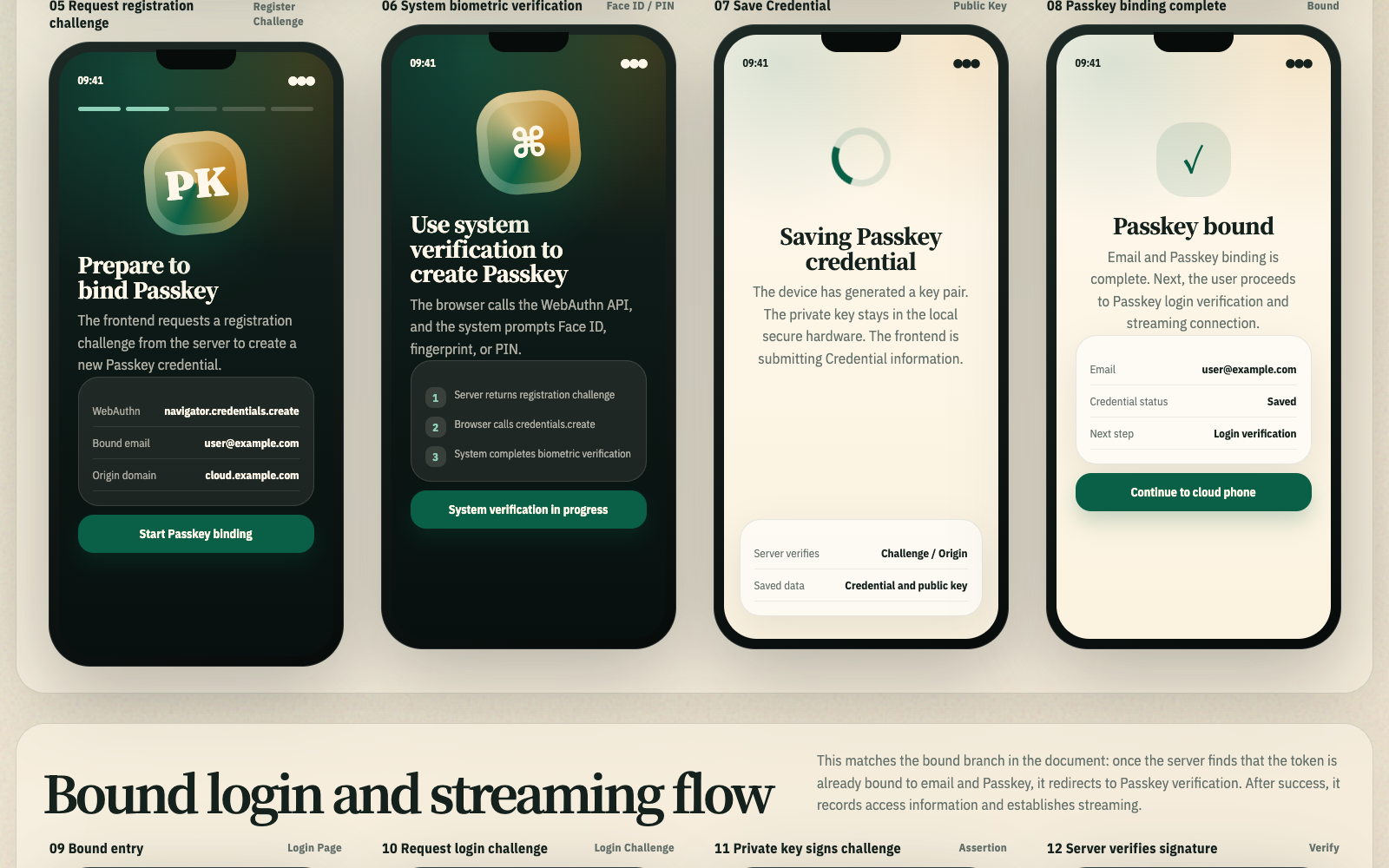
The public website borrows its visual language from the mobile delivery prototype: physical document texture, strong security contrast, and clear Passkey states that make the process feel deliberate rather than generic.
The customer sees a simple journey, while the backend keeps each step bound to the delivery code, email binding session, challenge, credential, access record, and stream session.
The user opens /privacyPhone?code=.... The server checks that the code exists, is enabled, and belongs to a cloud phone.
If email and Passkey are not bound, the user enters email and receives a short-lived second binding link.
The browser calls navigator.credentials.create; the server verifies challenge, origin, RP ID, and stores the public key.
On later visits, the same delivery link jumps to Passkey login and calls navigator.credentials.get.
After assertion verification, the system records IP, user agent, result, access time, and linked stream session data.
The cloud phone stream starts only after Passkey verification and audit logging have completed.
Built for teams delivering dedicated digital environments across Europe: agencies, remote operations teams, customer support groups, and identity-sensitive business workflows.
Keep delivery links stable for customers while keeping the real authority in server-side checks, Passkey credentials, and auditable stream sessions.
The website avoids overclaiming certification status. It explains concrete controls the product can implement: hashed delivery codes, short-lived challenges, origin validation, credential binding, audit records, and admin-controlled rebinds.
Codes are treated as lookup material, not plain database secrets. A disabled or invalid code cannot reach binding, login, or streaming.
Register and login challenges are short-lived, single-use, and tied to the delivery code, binding session, or credential.
A Passkey credential must belong to the current delivery code. Credentials cannot be reused across unrelated cloud phone links.
Changed device, lost credential, or failed Passkey recovery routes through an administrator or agent generated binding link.
The service is not positioned as a generic emulator page. It is a controlled gateway for phone environments that need customer identity, repeatable access, and operational records.
Provide each customer or operator a dedicated mobile environment with passwordless return access.
Agents can hand off cloud phones through links while administrators keep switch, rebind, and audit controls.
Support teams can access region-specific phones without exposing device credentials in chat or documents.
Lost Passkeys and changed devices are intentionally handled through admin rebind, not client-side bypass.
Use the Passkey delivery model to test long-lived access codes, first-time email binding, return-user authentication, audit records, and secure streaming before broader rollout.